The One Thing to Get Right This Weekend

I don’t usually listen in on other people’s phone conversations, but today I couldn’t help but overhear my coworker laughing, and chatting up the person on the other end of the line who had just called into our office. She’s like that. One of those people that treats you like you matter regardless of how busy she is. She remembers details and things like a person’s birthday or when their kids are sick. And, as I’m listening, I’m thinking that person on the other end is grateful because who doesn’t like to be valued like that?

I remembered one of my favorite moments this year at the Global Leadership Summit happened in session #5 with John Maxwell. He just up and said:

“Are you adding value to people or are you wanting people to add value to you?”

The room was quiet because he had obviously struck a nerve with several people. When we look at that through the lens of how we go about making guests feel welcome in our church, we have to ask ourselves, “Is our primary motive in creating a welcoming process to add value to our church or to add value to the other person?” Wanting to help someone who doesn’t have a church home find one isn’t a bad thing and wanting our church to grow in the process isn’t a bad thing either. The problem lies in that being our primary motivation.

We may put a lot of effort into welcoming someone into our church this Christmas and they may never come back.

What we hope though is that they leave feeling better than when they came and that because of that experience it stirs in them a desire to explore a relationship with Christ.

As Christmas weekend approaches and your church prepares to have more services, more people, more kids, more everything, there are plenty of things you can do to make people feel welcome. For some of those practical ideas you can go here.

But if you’re going to get one thing right this weekend, let it be how you add value to the people that walk through your doors. Take time to talk with people even when you’re busy. Train your volunteers to go above and beyond. In fact, if your welcome process doesn’t include margin for connecting with people then it’s not really a welcoming process; it’s just a process.

At the end of the day…when the lights go down and the doors close…ask yourself,

“Did I add value to someone’s life today?”

Maxwell goes on to say,

“Everything worthwhile is uphill. Everything.”

This weekend, wherever you are, ask God to reveal to you where he wants you to do this. It could be the person sitting in your pew by themselves or the person you’re thinking about inviting to church this weekend.

Make someone feel significant this Christmas, because as Maxwell says,

“Significance is not about me, it’s about others. Significance is all uphill, but there is a downhill habit that fights against significance and that is selfishness.”

If you’re still looking for a way to add value during this season, start with adding it to someone else’s life first. Because adding value to a person is an uphill habit, but the side effects are worth it.


5 Ways Your Church Can Stay Connected to Guests After They Visit

Last week, we revealed data on the research we’ve been doing over the past year concerning how churches are following-up with their visitors.  Here’s what we found:

“More than 75% of the time churches aren’t following up
with visitors that leave their contact information.”

Churches are missing out on following up with first-time (or second, or third-time) guests in a big way and the message being sent is that people who want to get plugged into a church aren’t important. In business (yes, I know churches aren’t businesses, but hear me out) they understand that if a customer expresses interest in something and doesn’t get a response, they likely aren’t going to do business with that company. The same is true for our churches. If a guest hears your call from the pulpit encouraging them to leave their contact information and then you don’t contact them, they take that to mean you aren’t interested, and they likely won’t come back again.

We are approaching one of the highest attended services of the year (Christmas) and this year, Christmas day happens to fall on a Sunday. Many churches will be holding services on those days and seeing a lot of first-time guests. Now is the right time to prepare for that so you aren’t wasting your opportunity. Things you need to remember:

  1. Don’t Wait. Remember that if someone leaves you their information that means they WANT to hear from you. Follow up quickly (within 24-36 hours).
  1. Make contact in a unique and personal way. People are desensitized to emails and form letters. They are impersonal and don’t leave a lasting impression. Consider a brief front-porch visit with a small gift in tow, such as fresh baked bread. If a visit isn’t something you want to do, consider a hand-written note. Either of those set you apart from the barrage of communication they receive each week.
  1. Don’t quit. Invite them back the following Sunday. Another contact on Thursday or Friday is a great way to remind them about the church and that you are hoping to see them again. Too often, churches send out a one-time letter thanking a guest for coming and then the outreach ends. While we certainly don’t want to bombard people with communications, we also don’t want to stop after one try. You never know when that one touch is going to be what drives a person to consider coming back to the church.
  1. Stay connected. Add guests to your monthly e-note or newsletter, invite them to upcoming events, seeker-friendly message series, and special services such as Easter and Christmas. You never know which time could make the difference in getting them to return.
  1. Do it. Make guest follow-up part of your weekly tasks. The only bad follow-up is not following up at all.

Remember the part in the book of Matthew where Jesus tells His disciples to go and make disciples of all nations? That’s exactly what this is. Following up with guests is a ministry outreach arm of the church. You’ve succeeded in getting them to come and to leave their contact information. Here is where ministry can start to happen, but it won’t happen if you aren’t intentional about doing it.

About Faith Perceptions
Faith Perceptions is a market research firm that provides churches and faith-based organizations with research about their target market. We send mystery guests into churches across the country each week to report back to us on what their experiences are like. We use this information to help churches improve the way they welcome and connect with guests. Faith Perceptions has been evaluating the first-time guest experience since 2008.

Guest Follow-Up: Why It Matters and Why It’s Not Happening

I went for a job interview. I remembered to smile, sit up straight, and not give canned answers. After the interview they said I’d definitely hear from them soon. They never contacted me.

I had a nice evening out with a friend of a friend. I gave my phone number, but never received a call.

My family attended a new church and loved it! The church asked us to fill out a connect card so that we could stay in touch with what was happening at the church and hopefully get connected. It’s been months…and still no contact.

What do these three scenarios have in common? Rejection.

Over the years, we’ve noticed in our research that churches weren’t being diligent in following up with guests. This past year, we decided to see if our anecdotal fears of the church not following up with people were factually based. In our study of the first-time guest experience, we concentrated specifically on guests that left their contact information with the church and tracked whether they received follow up.

About the Research
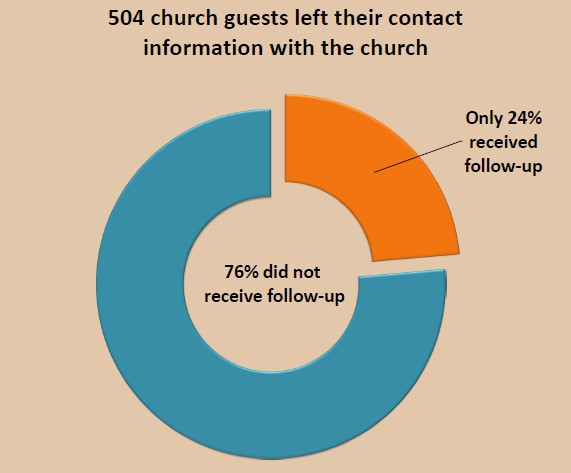
This research was conducted by Faith Perceptions using an online survey with a sample size of 1,341 adults who attended worship services at churches throughout the United States. The surveys were completed from October 2015 to September 2016.  First-time guests visited different churches of different sizes and denominations and, after being asked by the church to leave their contact information, 504 voluntarily chose to do so. After a period of 30 days following their visit to the church, Faith Perceptions followed up with each respondent to learn if the church had contacted them in any way. We found that only 119 (24%) of 504 respondents received follow up from the church.  Of the 504 adults that took part in this research, 359 were unchurched or dechurched.

blog-image

What’s the takeaway?
A meager 24% follow-up rate tells us that churches are neglecting the opportunity they have in connecting with guests. The message it sends to a guest is that the church doesn’t care and that they don’t matter.

Why aren’t churches following up?
In many of our conversations with church leaders, we learned that most do want to follow up, but don’t have a well-thought out process for doing so. There is often confusion on who should follow up and when. For those that have established a process, there is little to no accountability to ensure follow up is happening. Many pastors would like to do the follow up themselves, but lack the time and instead hope those appointed to do so are doing it.

Why it matters.
First things first, if someone gives you their contact information that means they WANT to hear from you. A set plan needs to be in place for following up quickly and consistently. Guest follow-up is a ministry, and just like any other ministry in your church, it needs attention. If you don’t have relevant programming and volunteers to staff your children’s ministry, do you think it will grow? Probably not. If you don’t put forth that same effort in reaching out to guests, your church probably isn’t going to grow, either.

What you can do.
Don’t wait. This is something your church can start doing today and it costs very little, if anything at all. Whether it’s making a phone call, sending an email, or dropping a postcard in the mail – contact should be made. Contacting a guest after they visit shows them they are a priority…that they matter. Regardless of how you do it…do it. The worst kind of church follow-up is no follow-up at all.

For some practical ways to start effectively following up with guests at your church, check out part two of this blog here.

About Faith Perceptions
Faith Perceptions is a market research firm that provides churches and faith-based organizations with research about their target market. We send mystery guests into churches across the country each week to report back to us what their experiences are like. We use this information to help churches improve the way they welcome and connect with guests. Faith Perceptions has been evaluating the first-time guest experience since 2008.

How to Lose a Guest in One Sunday

Have you ever tried so hard to accomplish something (like seeding the lawn…or putting together that chair from IKEA with a million little pieces), but you end up with a bigger mess than when you started? Sometimes getting guests to return to your church is like that. You did all the right things (you think) to make a first-time guest feel welcome. So, why didn’t they come back? Sometimes it has nothing to do with the church itself. Some people just aren’t ready to come back to church. Sometimes though, they are ready, but what they experience when they get there isn’t what they hoped for.

Each week, we read through feedback from first-time guests on their church experiences. Here are some common themes as to why a guest doesn’t return.

Unwelcoming Congregation
Picture walking into a church you have never visited before. There are groups of people gathered talking and visiting with one another….and no one (outside of the greeter who handed you your bulletin) speaks to you.  While that may not be intentional on the church’s part, it’s happening…a lot.

mg-quote-1

Being Too Friendly
This might strike some as odd, but it’s true. There’s a fine line in being welcoming and being too friendly. While your first-time guests don’t want to be ignored, they most likely won’t be up for playing a game of 20 questions either. One church guest had this to say about their visit:

mg-quote-2

I’m sure this church had the best intentions in making this guest feel welcome, but in the end it was too much and drove the guest away.

Nothing for Kids
This seems pretty obvious, but there are still many churches out there that do not offer any form of ministry for kids. If a family visits your church only to find out that there is nothing offered in the way of discipleship for their kids, they most likely won’t be back. If your kids’ ministry is non-existent or exists, but could use some work, check out our blog from last week.

No Information
Your church may offer a lot of ministry opportunities, but how are you relaying that information to someone new? We routinely visit church websites and find little to no information on what the church offers outside of Sunday morning. And, when the website does mention these things, it often includes “internal speak” that a guest is not going to understand. Your website IS the front door for your church and should be geared towards the people you are trying to reach, not the people who are already there.

An Aging Congregation

mg-quote-3

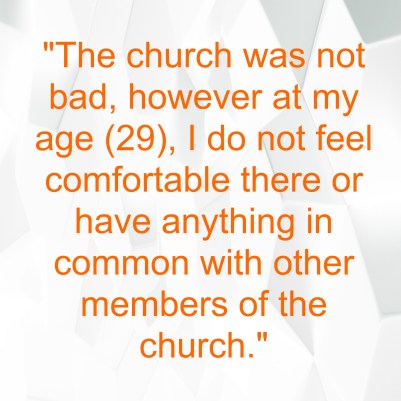
We see this most often with young adults. The church can be really welcoming, but at the end of the day if there aren’t people attending they can identify and do life with they will most likely move on. You may not be able to change the age diversity in your church overnight, but intentional outreach and ministries geared towards a younger generation will help, and demonstrates your church’s openness to connecting with that demographic.

Mediocre Church
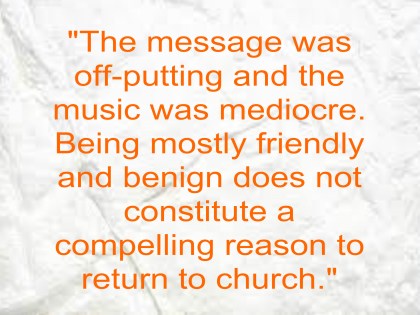
This one is probably going to bother some people, but it has to be said. Whether we are talking about outreach, the teaching, worship music, hospitality, cleanliness, punctuality, etc., we should be doing it in truth and with excellence.

mg-quote-4

We write this not to condemn, but to challenge your church to be better. Every church has something they can improve on….even the really great ones.

Are Kids’ Impressions Affecting Church Attendance?

Recently, I had a conversation with a friend about the challenges of getting her kids to church. This friend is the mom of two young kids and one on the way. She makes the parenting thing look pretty simple most of the time, but her kids get bored at church and sometimes put up enough of a struggle on Sunday mornings that the whole family skips church altogether because it’s just easier. Continue reading

Does Back to School Mean Back to Church?

If you were to ask pastors how their church attendance is affected during the summer months, most would probably admit to seeing a “summer slump” that can last through Labor Day. It’s not unusual for people to be busier during the summer with camps, vacations, family time, and sleeping in just because they can. These things aren’t necessarily bad, but they

Continue reading

5 Ways to Prepare for and Follow Up with Guests this Easter

Easter is the highest attended service of the year which means more people are likely to visit your church on this day than any other. 

So, what are you doing to prepare? Here are some quick ideas that you can implement in the short time we have left:

  1. The Front Door– The website is usually a person’s first point of contact. Scan your site and make sure worship times are easy to find. Directions and what to expect (especially for families) should be clear. Have an “I’m New” or “First-Time at [church name]” page where guests can get the basics about their first visit.
  2. Parking Ministry – With more guests, there’s more traffic, and a need for more places to park.  Hospitality begins in the parking lot and our mystery guests rate their overall experience higher in churches with parking ministries.
  3. More Hands on Deck – Increase your capacity for hospitality by adding more volunteers. If you average 5-10 guests a month, plan on seeing at least triple that at your Easter services, many of which will be families with kids.

Greeting – Add more greeters and a ‘friendly patrol’ to welcome new faces and start conversations before and AFTER the service.

Seating – Plan for overflow. In the weeks leading up to Easter, ask members to prepare by leaving the back and end seats open for guests. Encourage them to attend earlier services since guests are more likely to attend a later service on their first visit. Add more seating and plan to add even more should it become necessary.

Kids Ministry – Many of those new faces you see will be families who won’t know what you offer for kids or where they should take them. That means Kids Ministry needs to ramp up as well to help check kids in, answer questions, and guide families to their destinations.

4. Information – When a guest has the information they need to take next steps, they’re more likely to take them.

Guest Card – Upon arrival, give them the basics. In the back of every seat or inside every bulletin have a guest card that explains where the restrooms, welcome desk, and kid’s ministry are located.

Connect card – Give them a way to leave their contact information and how to leave it. Calling it a “connect card” best communicates why you are asking for this information – to connect with them! Some churches will ask guests to turn it in at the welcome center and receive a gift. Other churches donate to a local charity for each one they receive.

Gift and Ministry Information – Hospitality is a ministry and needs to be treated as such. A gift thanking guests for coming and a well-designed brochure that tells more about the church’s ministries and how to get plugged in leaves a guest feeling important and informed.

Tell them what’s coming next week – A church I attended always followed Easter up with the series “I have a friend who struggles with….[divorce, pornography, etc.]” Attendance always spiked because of the interest these relevant topics would generate.

5. Plan your follow up and see it through –  Too many guests in our research report leaving their contact information and never receiving follow up. I cringe every time I read about it. Nothing says that you’re not actually interested the guest coming back than neglecting to follow up with them. The key to follow up is to be intentional about it and don’t wait.

Following up is one of the most important things you can do.

  • 24 hours: Send an email, text, or make a phone call thanking them for coming.
  • 96 hours: Mail a note inviting them back and a reminder about the upcoming message series.

Easter is important, but you can use these ideas for every service. Be intentional about planning: from the initial welcome through the follow up.

What are some other ideas that you’ve seen implemented before?